Nutrition: How the Body Uses FoodChapter 1
Energy and the Macronutrients
In this chapter
This chapter is about what happens to food after it is eaten — how much energy it carries and where the body spends it, how it is broken down and taken in, what becomes of the carbohydrate, fat and protein, how the body keeps its water — and, last, how to read the studies that claims about food rest on. It teaches , , , , , and as science; it does not tell you what to eat.
Energy: The Kilocalorie, and Where the Body Spends It
Food carries chemical energy, measured in kilocalories — the food "Calorie", about 4.2 kJ (kilojoule), the heat that warms a kilogram of water one degree. Energy balance is intake against expenditure: the body spends on rest, digestion and movement, and stores what it does not spend.
Place any "calorie" claim on one side of the balance, in one share: rest is a sedentary adult's largest, roughly 60–75%; digesting food about a tenth; movement the rest. As physics, energy unspent is stored; as physiology, expenditure moves — falling as a body shrinks, adjusting to intake — so the sum is not fixed.
A hypothetical label — 10 g protein, 30 g carbohydrate, 5 g fat — comes to 205 kcal (kilocalorie) at the standard 4, 4 and 9 kcal (kilocalorie) per gram, worked below; the body's yield differs by food.
"The label's calories are what the body gets." Labels use average factors; in people, the factors overstated almonds by a third, and protein costs 20–30% of its energy to process. "Sitting still burns almost nothing." Rest is the largest share; heartbeat, breathing and cell chemistry never stop. "500 kcal (kilocalorie) less a day is a pound a week, for ever." That rule holds expenditure fixed; it falls as weight falls, so loss slows and stops.
- Read the grams of each macronutrient. The hypothetical label: 10 g protein, 30 g carbohydrate (of which 4 g fiber), 5 g fat.
- Apply the general factors — 4 kcal (kilocalorie) per gram of protein and of carbohydrate, 9 per gram of fat: kcal (kilocalorie).
- Convert to kilojoules if wanted: kJ (kilojoule).
- Say what the number is. An estimate from average factors, one of several methods U.S. labeling permits — another subtracts the fiber from the carbohydrate first, giving and a total of kcal (kilocalorie) — and not a measurement of what any one body absorbs.
The common slip is treating step 2's answer as the energy the body will get: the factors are averages over foods, and the fiber variant shows the label itself can move by 16 kcal (kilocalorie) on a definitional choice.
Digestion Breaks Food Down; Absorption Takes It In
Digestion breaks food down — mechanically by chewing and churning, chemically by enzymes that cut large molecules into small ones: starch to sugars, protein to amino acids, fat to fatty acids and glycerol. Absorption moves those molecules across the gut wall into blood or lymph, almost all in the small intestine.
Follow the molecule: ask whether it was cut small enough, and where it crossed. Whole proteins and starches do not enter blood; amino acids and glucose do, through the small intestine's lining; fats go first by lymph. Fiber, which no human enzyme can cut, is not absorbed as such; in the large intestine bacteria ferment some.
A hypothetical bowl of rice and beans: the stomach churns it and pepsin begins on the protein; in the small intestine, pancreatic and gut-lining enzymes finish starch to glucose and protein to amino acids, which cross into blood over the next hours; the fiber passes on.
"Digestion and absorption happen in the stomach." The stomach churns and starts on protein; nearly all absorption is in the small intestine, the large intestine mostly recovering water. "Protein enters the blood as protein." As amino acids, or not at all. "Fiber does nothing." Human enzymes cannot cut it, but it speeds passage and colon bacteria ferment part of it.
Digestible Carbohydrate Arrives in the Blood Mostly as Glucose, and Blood Glucose Is Regulated
Carbohydrates are sugars, starch and fiber; the digestible ones arrive in the blood mostly as glucose. Blood glucose is regulated: insulin moves glucose into cells and into glycogen stores in liver and muscle, and glucagon draws it back out, holding the level in a narrow band between meals.
Ask what the loop is doing, not what the meal was: rising glucose → insulin → uptake and storage; falling glucose → glucagon → glycogen breakdown and new glucose from lactate, glycerol and amino acids. Surplus glucose goes into glycogen first; conversion to fat waits until those stores are full.
Hypothetical: after a rice dinner, Tomas's blood glucose rises and falls back within hours as insulin acts; at three in the morning glucagon holds it steady from liver glycogen; by mid-morning, still unfed, his liver is making new glucose.
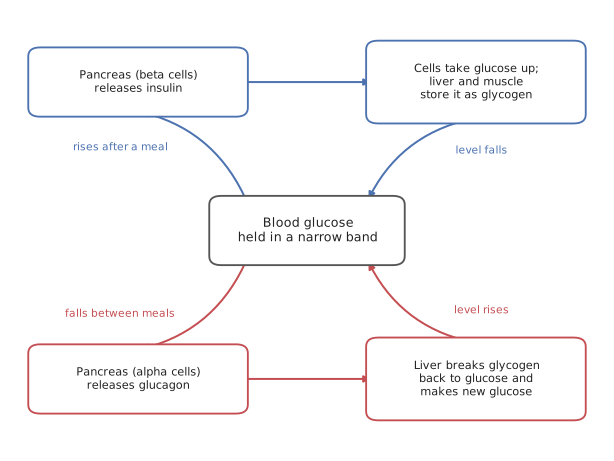
"No sugar or starch means no glucose in the blood." The liver makes it from lactate, glycerol and amino acids; the loop keeps the level up. "Blood glucose just tracks the last meal." Two hormones hold it in a band; the meal is a disturbance the loop corrects. "Unused carbohydrate turns straight into fat." Glycogen first; in the men measured, fat synthesis rose only once stores of about 15 g per kilogram were full.
Fats: The Densest Fuel, a Routine One, and Two the Body Cannot Make
Dietary fats are mostly triglycerides — three fatty acids on a glycerol — digested with bile's help, absorbed by way of the lymph, and denser in energy than the other macronutrients: about 9 kcal (kilocalorie) per gram against 4. The body burns fatty acids as a routine fuel, stores surplus energy from any source as fat, and cannot make two fatty acids it needs.
Keep three roles apart: fuel — fatty acids released between meals and at rest as glucagon rises; store — triglyceride in fat tissue, built from dietary fat or from surplus glucose; nutrient — linoleic and alpha-linolenic acid, which must come from food, and the vitamins absorbed only with fat.
Hypothetical Farah eats little fat but a year-long surplus of rice and bread, and gains fat: with glycogen full, her liver built fatty acids from surplus glucose — stored energy from a fatless source.
"Body fat comes from eating fat." It is surplus energy of any kind; excess glucose becomes fatty acids. "The body doesn't need dietary fat." It cannot make linoleic or alpha-linolenic acid, and absorbs vitamins A, D, E and K only with fat. "Fat is only burned in starvation." Falling glucose between meals releases fatty acids for fuel every day; starvation deepens the reliance rather than beginning it.
Proteins: Amino Acids in Turnover, Not in Store
Proteins are chains of twenty amino acids, nine of which the body cannot make and must obtain from food. Digested to amino acids, dietary protein feeds the pool from which the body's own proteins are continually broken down and rebuilt; there is no store for the surplus.
Follow the amino acid: into a protein being built, or — if none is wanted — stripped of its nitrogen, which leaves as urea in urine, while the carbon skeleton is burned, made into glucose or, in surplus, fat. Ask what is being built before predicting what more protein will do.
Hypothetical Ravi doubles his protein and changes nothing else; his body already makes all the protein it needs, so the surplus becomes urea and fuel, not muscle.
"More protein means more muscle." Muscle is built to demand, not supply: in 49 trials of adults doing resistance training, gains in lean mass stopped rising once intake passed about 1.6 g per kilogram a day. "The body keeps a protein reserve like its fat reserve." It has no storage mechanism; in starvation it breaks down working muscle, which is a loss, not a withdrawal. "Protein is protein." Nine amino acids must arrive from food, whatever the total.
Hydration Is Water Balance, Regulated by Thirst and the Kidney
Water balance is water in — drink, the water in food, a little made by metabolism — matched against water out in urine, sweat, breath and stool, so that the body's water, half to three-fifths of an adult's mass, holds steady. Thirst and the kidney, under antidiuretic hormone, regulate it; no quota does.
Ask what the regulators are doing: blood slightly too concentrated → hypothalamic sensors → thirst and ADH (antidiuretic hormone) → the kidney reabsorbs water, less urine; blood dilute → less ADH (antidiuretic hormone) → more urine. Count every source and every loss, not glasses.
A hypothetical adult takes in about 2.5 L a day — a fifth in food, 230 mL made in cells — and loses about as much, 1.5 L as urine; on a quiet day with little drink, less urine and no thirst are the balance holding.
"Eight glasses of plain water a day; coffee doesn't count." No study supports the rule; the U.S. reference intakes count food and every beverage, coffee included, and set no rule in glasses. "Thirsty means already dehydrated." Thirst is the regulator answering a small rise in blood concentration — the system working, though heat, exertion, illness and age can outrun it. "Balance is only about drinking." The kidney adjusts outflow hour by hour.
Reading Nutrition Evidence: What a Study Can and Cannot Show
An observational study records what people eat and what happens to them; a randomized controlled trial assigns the food by lot and compares outcomes. The first shows association, not by itself cause; the second can, but only for its intervention, people and time.
Three questions of any claim: what was measured, and how — self-report understates energy intake by a tenth to a third; who was compared with whom, and what else differed; and what it could not show — a null result is silent beyond its own dose, people and years.
In one trial's placebo group, men who took at least 80% of their inert pills had 15.1% five-year mortality against 28.3% for the rest: faithful pill-taking marked a kind of person, who did better regardless.
"People who eat X have less Y, so X prevents Y." X-eaters differ in health, wealth and habits; the placebo adherers show how much that carries. "A trial settles it." The Women's Health Initiative assigned 48,835 women to a low-fat pattern and found no significant fall in heart disease or breast cancer — an 8-point cut in fat, not the 20 % target, over eight years, not forty; a trial says what it can. "Studies measure what people ate." Usually what they say they ate.
Observational studies had found that people who ate more carotenoid-rich fruit and vegetables, and who had more beta-carotene in their blood, got less lung cancer. From 1985 to 1993 a randomized trial gave 29,133 Finnish male smokers aged 50 to 69 beta-carotene, vitamin E, both, or a placebo, expecting to see the protection. Instead, lung cancer incidence was 18% higher among the men who received beta-carotene (95% confidence interval 3 to 36%), and total mortality 8% higher. The association had been real; the cause was not the pill, or not in that form and dose.
One Meal, All Seven IdeasSynthesis
A last hypothetical: rice, lentils, a spoon of oil and a glass of water for dinner, and a headline next morning saying such dinners "protect the heart". The label's number is an estimate from average factors, and the body's will count what it absorbs against a day whose largest cost was being alive at rest.
Nothing in the bowl reaches the blood as it is: cuts the rice's starch to glucose and the lentils' protein to amino acids, the oil goes by the lymph, the fiber on to the colon. The glucose that arrives is a disturbance the corrects with insulin, and by dawn glucagon will be holding the level from liver glycogen while muscle burns — the routine fuel, and the store any surplus would have joined.
The amino acids join a pool in constant ; whatever is not built is deaminated and burned. The water, with the water in the food, enters a the kidney and thirst are already managing.
And the headline: who was compared with whom, what was measured and how, and what the study could not have shown — , asked before belief.
Sources
- 1 OpenStax Anatomy and Physiology (first edition), Preface — the licence statement — source
- 2 OpenStax Anatomy and Physiology §24.1: Overview of Metabolic Reactions — source
- 3 OpenStax Anatomy and Physiology §24.2: Carbohydrate Metabolism — source
- 4 OpenStax Anatomy and Physiology §24.3: Lipid Metabolism — source
- 5 OpenStax Anatomy and Physiology §24.4: Protein Metabolism — source
- 6 OpenStax Anatomy and Physiology §24.5: Metabolic States of the Body — source
- 7 OpenStax Anatomy and Physiology §24.6: Energy and Heat Balance — source
- 8 OpenStax Anatomy and Physiology §24.7: Nutrition and Diet — source
- 9 OpenStax Anatomy and Physiology §23.2: Digestive System Processes and Regulation — source
- 10 OpenStax Anatomy and Physiology §23.5: The Small and Large Intestines — source
- 11 OpenStax Anatomy and Physiology §23.7: Chemical Digestion and Absorption: A Closer Look — source
- 12 OpenStax Anatomy and Physiology §17.9: The Endocrine Pancreas — source
- 13 OpenStax Anatomy and Physiology §26.1: Body Fluids and Fluid Compartments — source
- 14 OpenStax Anatomy and Physiology §26.2: Water Balance — source
- 15 OpenStax Anatomy and Physiology 2e §24.7: Nutrition and Diet (consulted only — CC BY-NC-SA 4.0 by its preface and page footer, not adapted) — source
- 16 U.S. Department of Agriculture and U.S. Department of Health and Human Services, Dietary Guidelines for Americans, 2020–2025, 9th ed. (Dec 2020), Appendix 1 Table A1-2 (Daily Nutritional Goals, Ages 2 and Older) and Appendix 2 Table A2-2 (Estimated Calorie Needs per Day) — U.S. government work, public domain; cited for figures and definitions only — source
- 17 21 CFR §101.9(c)(1)(i), Nutrition labeling of food — the permitted methods for calculating calories, including the general factors of 4, 4 and 9 calories per gram (U.S. federal regulation, public domain) — source
- 18 NIST Special Publication 811, Guide for the Use of the International System of Units (SI), Appendix B.8 — the calorie and kilocalorie (nutrition) conversion factors to the joule (U.S. government work, public domain) — source
- 19 National Institute of Diabetes and Digestive and Kidney Diseases (NIH), 'Your Digestive System & How It Works' (reviewed Dec 2017; copyright-free by NIDDK's own statement) — source
- 20 NIH Office of Dietary Supplements, 'Omega-3 Fatty Acids: Fact Sheet for Health Professionals' — the definition of an essential fatty acid and the ALA reference intakes (U.S. government work) — source
- 21 Centers for Disease Control and Prevention, Principles of Epidemiology in Public Health Practice, 3rd ed., Lesson 1 §7 'Analytic Epidemiology' — experimental versus observational studies, cohort, case-control and cross-sectional designs (U.S. government work) — source
- 22 National Cancer Institute, 'Antioxidants and Cancer Prevention' fact sheet (reviewed Feb 6, 2017) — the ATBC and CARET trial summaries (U.S. government work) — source
- 23 K. R. Westerterp, 'Diet induced thermogenesis', Nutrition & Metabolism 1:5 (2004), doi:10.1186/1743-7075-1-5 — CC BY 2.0 — source
- 24 E. T. Trexler, A. E. Smith-Ryan & L. E. Norton, 'Metabolic adaptation to weight loss: implications for the athlete', Journal of the International Society of Sports Nutrition 11:7 (2014), doi:10.1186/1550-2783-11-7 — CC BY 2.0 — source
- 25 K. D. Hall & C. C. Chow, 'Why is the 3500 kcal per pound weight loss rule wrong?', International Journal of Obesity 37 (2013) 1614, doi:10.1038/ijo.2013.112 (consulted) — source
- 26 E. Fothergill et al., 'Persistent metabolic adaptation 6 years after "The Biggest Loser" competition', Obesity 24(8) (2016) 1612–1619, doi:10.1002/oby.21538 (consulted) — source
- 27 J. A. Novotny, S. K. Gebauer & D. J. Baer, 'Discrepancy between the Atwater factor predicted and empirically measured energy values of almonds in human diets', American Journal of Clinical Nutrition 96(2) (2012) 296–301, doi:10.3945/ajcn.112.035782 (consulted) — source
- 28 K. J. Acheson et al., 'Glycogen storage capacity and de novo lipogenesis during massive carbohydrate overfeeding in man', American Journal of Clinical Nutrition 48(2) (1988) 240–247, doi:10.1093/ajcn/48.2.240 (consulted) — source
- 29 K. D. Hall et al., 'Ultra-processed diets cause excess calorie intake and weight gain: an inpatient randomized controlled trial of ad libitum food intake', Cell Metabolism 30(1) (2019) 67–77, doi:10.1016/j.cmet.2019.05.008 (consulted) — source
- 30 R. W. Morton et al., 'A systematic review, meta-analysis and meta-regression of the effect of protein supplementation on resistance training-induced gains in muscle mass and strength in healthy adults', British Journal of Sports Medicine 52(6) (2018) 376–384, doi:10.1136/bjsports-2017-097608 (consulted; CC BY-NC by its notice, not adapted) — source
- 31 National Research Council, Recommended Dietary Allowances, 10th ed. (National Academies Press, 1989), Summary — the protein allowance of 0.8 g per kg body weight for adults (consulted) — source
- 32 MedlinePlus Medical Encyclopedia, 'Amino acids' (A.D.A.M.; reviewed 2025-01-21) — the nine essential amino acids (consulted) — source
- 33 The National Academies, news release 'Report Sets Dietary Intake Levels for Water, Salt, and Potassium To Maintain Health and Reduce Chronic Disease Risk', Feb 11, 2004 — the water reference intakes, the 80/20 beverage-and-food split, and 'no rule of thumb' (consulted) — source
- 34 H. Valtin, '"Drink at least eight glasses of water a day." Really? Is there scientific evidence for "8 × 8"?', American Journal of Physiology–Regulatory, Integrative and Comparative Physiology 283(5) (2002) R993–R1004, doi:10.1152/ajpregu.00365.2002 (consulted) — source
- 35 The Alpha-Tocopherol, Beta Carotene Cancer Prevention Study Group, 'The effect of vitamin E and beta carotene on the incidence of lung cancer and other cancers in male smokers', New England Journal of Medicine 330(15) (1994) 1029–1035, doi:10.1056/NEJM199404143301501 (consulted) — source
- 36 B. V. Howard et al., 'Low-fat dietary pattern and risk of cardiovascular disease: the Women's Health Initiative Randomized Controlled Dietary Modification Trial', JAMA 295(6) (2006) 655–666, doi:10.1001/jama.295.6.655 (consulted) — source
- 37 R. L. Prentice et al., 'Low-fat dietary pattern and risk of invasive breast cancer: the Women's Health Initiative Randomized Controlled Dietary Modification Trial', JAMA 295(6) (2006) 629–642, doi:10.1001/jama.295.6.629 (consulted) — source
- 38 Coronary Drug Project Research Group, 'Influence of adherence to treatment and response of cholesterol on mortality in the Coronary Drug Project', New England Journal of Medicine 303(18) (1980) 1038–1041, doi:10.1056/NEJM198010303031804 (consulted) — source
- 39 A. F. Subar et al., 'Using intake biomarkers to evaluate the extent of dietary misreporting in a large sample of adults: the OPEN study', American Journal of Epidemiology 158(1) (2003) 1–13, doi:10.1093/aje/kwg092 (consulted) — source
- 40 J. D. Schoenfeld & J. P. A. Ioannidis, 'Is everything we eat associated with cancer? A systematic cookbook review', American Journal of Clinical Nutrition 97(1) (2013) 127–134, doi:10.3945/ajcn.112.047142 (consulted) — source