Economics: How People ChooseChapter 1
Choice and Cost
In this chapter
This chapter gives you four questions economists ask of any choice — what the limit is, what the choice really costs, which costs no longer matter, and how much of a thing is worth doing — and one consequence of them: why trading with someone worse at everything can still pay. It teaches what , , , and are; it does not tell you what to do with your own money.
Scarcity Means Every Choice Is a Trade-off
Scarcity means that what people want — goods, services, time — exceeds what is available to satisfy it. Because of it every choice is a trade-off: choosing one thing is also choosing against another.
Ask what the limit is — money, hours, workers, land — and what else it could have gone to. If one option leaves less of it for another, the trade-off is real, money or no money. Wealth widens the possible; it does not remove the edge.
A hypothetical island grows fruit and catches fish. Everyone fishing lands the most fish and no fruit; people sent to the orchards raise fruit and lower fish. The curve of every combination it can just reach — its production possibilities frontier — is its menu of trade-offs.
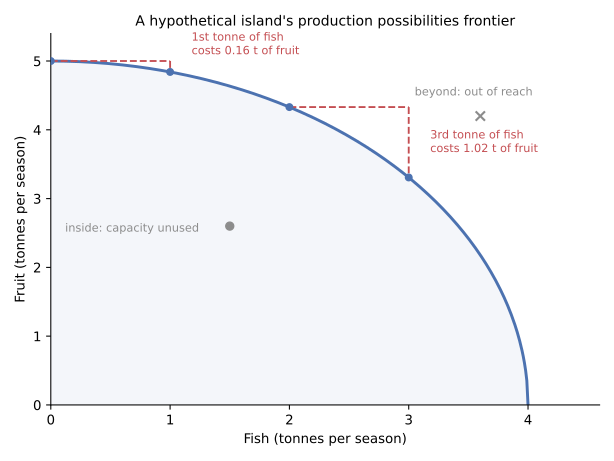
"Scarcity is just a fancy word for poverty." Wealth loosens the money limit, not the hours in a day; the rich cannot be at two dinners at once either. "A choice with no money in it isn't really an economic trade-off." Time is scarce too; an evening given to one thing is taken from another. "Once the economy grows enough, the trade-offs go away." Growth pushes the frontier outward; the choice returns on a bigger frontier.
Opportunity Cost Is the Next-Best Thing You Gave Up
The opportunity cost of a choice is the value of the next-best alternative given up to make it — the one thing you would actually have done instead; not the price, not everything else you could have done.
Ask what you would do instead if you did not do this. That one answer is the cost, in money, time or whatever it is made of. Money paid counts because it had another use; time counts even when nothing was paid.
A year of college costs its fees plus the wages a student would have earned in the hours spent in class and study — the opportunity cost is both.
"The opportunity cost of something is its price." Price is what you paid; the cost is what the money and the time could otherwise have done — why college costs more than its fees. "It's everything I could have done instead, added up." One evening goes one place; adding the rest counts it several times. "If it didn't cost me any money, it had no opportunity cost." Time spent one way is not spent another; economists cost even a half-hour in an airport queue.
Sunk Costs Are Gone Whatever You Choose Next
A sunk cost is a cost already paid — money, time or effort — that no present choice can recover. Being the same under every option, it is no reason to prefer any; only costs and benefits still to come are.
Ask of each cost whether it differs between the options still open. If it is gone either way, it is sunk and drops out. A forfeited deposit is sunk; instalments you can still cancel are future costs, not sunk.
A hiker (hypothetical) climbs for an hour before realizing the trail leads away from her lake. Turn back or press on, that hour is spent; what differs is how far each route still is. The sunk hour cannot decide it; the remaining walk can.
"I've put so much in that stopping now would waste it." The money is equally spent either way; only what is still to come can be saved or wasted. "Once I've committed, the whole cost is sunk — even the payments I haven't made yet." Only what cannot be recovered is sunk; an avoidable payment still counts. "Sunk costs are about money; time and effort don't count." An hour spent is as unrecoverable as a dollar spent; forget the money and the time that are gone.
In 1985 two psychologists reported an experiment at a university theatre in Ohio: the first sixty people to buy season tickets were charged, at random, the full 15 dollars, 13 dollars, or 8 dollars. Everyone then held the same tickets to the same plays. Over the first half of the season the full-price group attended more — about 4.1 plays against about 3.3 for each discount group; over the second half no significant difference remained. The money was sunk for all three groups the day they paid; for half a season, the ones who had paid most behaved as if it were not.
Deciding at the Margin: Is the Next Unit Worth It
A marginal decision is a choice about a little more or a little less, made by comparing the extra benefit of the next unit with its extra cost. Extra benefit usually shrinks as you have more: the law of diminishing marginal utility.
Ask not whether the activity is worth doing but whether the next unit is — its added benefit against its added cost, including the time's . Stop where the next unit adds less than it costs, even if every unit before was worth having.
A hypothetical student revising: the first hour fixes the biggest gaps; the fifth adds little and costs sleep before the exam. Revision is worth doing; the fifth hour may not be — worthwhile and one more are different questions.
"If it's worth doing, more is always better." Extra benefit falls with each unit while extra cost usually does not — Marshall's law of diminishing utility. "The last hour was worth it, because the whole effort paid off." A total can be good while its last unit was not; each unit is judged on what it alone added. "Nobody calculates like this, so it doesn't describe real decisions." A basketball player passes accurately without doing the physics; the physics still describes the pass.
Comparative Advantage: Why Trade Pays Even for the Better Producer
A producer has a comparative advantage in a good when making it costs them less in other goods given up — a lower — than it costs another producer. Absolute advantage, making more with the same resources, is different.
For each producer, work out what one unit of a good costs in the other good; the lower cost is the comparative advantage. With two goods the advantages are always opposite, so no producer holds both and each holds one. Specialize where cost is lower, trade, and both can end with more.
A lawyer types faster than her assistant (hypothetical). Her typing hour costs legal work; his costs far cheaper work. His typing is cheaper: the comparative advantage in it is his, the absolute advantage in both hers.
"If one side is better at everything, it gains nothing from trade." That is absolute advantage; the gain comes from each making what costs them least, and even the stronger side is relatively better at one thing. "Comparative advantage means being the best at making it." Being best is absolute advantage; the weaker producer still has the lower cost in one good. "An efficient enough country could have it in every good." Cheaper at one good means dearer at the other.
- Write each producer's output for each good. Hypothetical: in a day Ana can make 6 loaves or 3 pies; Ben can make 2 loaves or 2 pies. Ana has the absolute advantage in both.
- Turn outputs into . A pie costs Ana loaves; it costs Ben loaf. A loaf costs Ana pie; it costs Ben 1 pie.
- Compare, good by good. Pies are cheaper for Ben (1 loaf against 2); loaves are cheaper for Ana ( pie against 1). Ben holds the comparative advantage in pies, Ana in loaves — opposite, as they must be.
- Specialize and trade at a rate between the two costs. Ana bakes 6 loaves, Ben 2 pies. Ben trades 1 pie for loaves — between his cost of 1 and Ana's of 2. Ben ends with 1 pie and loaves, where alone a pie and a loaf was his limit; Ana ends with loaves and 1 pie, where alone one pie would have left her 4. Both have more than they could make by themselves.
The common slip is at step 3: comparing outputs (who makes more) instead of (who gives up less). Ana makes more of both; she still gains from Ben's pies.
The reasoning was set out by David Ricardo in 1817, with an example in which one country is the better producer of both goods and still gains by trading:
> England may be so circumstanced, that to produce the cloth may require the labour of 100 > men for one year; and if she attempted to make the wine, it might require the labour of > 120 men for the same time. England would therefore find it her interest to import wine, > and to purchase it by the exportation of cloth. To produce the wine in Portugal, might > require only the labour of 80 men for one year, and to produce the cloth in the same > country, might require the labour of 90 men for the same time. It would therefore be > advantageous for her to export wine in exchange for cloth. This exchange might even take > place, notwithstanding that the commodity imported by Portugal could be produced there > with less labour than in England.
— David Ricardo, On the Principles of Political Economy and Taxation, 3rd ed. (London: John Murray, 1821; first published 1817), chapter VII, "On Foreign Trade", the paragraph beginning "England may be so circumstanced".
One Decision, All Five IdeasSynthesis
One last hypothetical: two friends run a student café and are deciding whether to keep opening on Saturdays. There is one team and one Saturday — first, because whatever the day goes to, it cannot also go to the catering jobs they have been turning down.
The of a Saturday opening is therefore not the ingredients bill alone; it is, above all, the best catering job forgone that day. The sign they already painted and the deposit they already paid on the espresso machine are — gone whether they open or not — and drop out of the comparison, however much they hurt.
Whether Saturdays as a whole pay is one question; whether the last hour of a Saturday does is another — a about closing at four instead of five, judged on what that hour alone adds against what it costs.
And if one friend is faster at both baking and serving, that does not settle who does what: the one whose baking gives up less serving should bake — , and between them more gets done. Five questions, one decision; the answer is theirs, the questions are the chapter's.
Sources
- 1 OpenStax Principles of Economics 2e, Ch. 2 Introduction to Choice in a World of Scarcity — source
- 2 OpenStax Principles of Economics 2e §2.1: How Individuals Make Choices Based on Their Budget Constraint — source
- 3 OpenStax Principles of Economics 2e §2.2: The Production Possibilities Frontier and Social Choices — source
- 4 OpenStax Principles of Economics 2e §2.3: Confronting Objections to the Economic Approach — source
- 5 OpenStax Principles of Economics 2e, Ch. 2 Key Terms — source
- 6 OpenStax Principles of Economics 2e §1.1: What Is Economics, and Why Is It Important? — source
- 7 OpenStax Principles of Economics 2e §33.1: Absolute and Comparative Advantage — source
- 8 OpenStax Principles of Economics 2e §33.2: What Happens When a Country Has an Absolute Advantage in All Goods — source
- 9 OpenStax Principles of Economics 3e §2.1 (consulted only — CC BY-NC-SA 4.0 by its preface, not adapted) — source
- 10 David Ricardo, On the Principles of Political Economy and Taxation, 3rd ed. (London: John Murray, 1821; first ed. 1817), ch. VII 'On Foreign Trade' — the paragraph beginning 'England may be so circumstanced'; Library of Economics and Liberty text, public domain — source
- 11 Adam Smith, An Inquiry into the Nature and Causes of the Wealth of Nations (1776), Book IV ch. II, ed. Edwin Cannan (London: Methuen, 1904); Library of Economics and Liberty text, public domain — source
- 12 Alfred Marshall, Principles of Economics, 8th ed. (London: Macmillan, 1920; first ed. 1890), Book III ch. III 'Gradations of Consumers' Demand'; Library of Economics and Liberty text, public domain — source
- 13 Hal R. Arkes & Catherine Blumer, 'The psychology of sunk cost', Organizational Behavior and Human Decision Processes 35(1) (1985), 124–140, doi:10.1016/0749-5978(85)90049-4 (consulted) — source
- 14 Libby Rittenberg & Timothy Tregarthen, Principles of Economics v2.0, ch. 1 'Economics: The Study of Choice' and ch. 2 'Confronting Scarcity: Choices in Production' (Saylor Academy edition; consulted for scope and definitions, not adapted) — source
- 15 Wikipedia, 'Sunk cost' (consulted for the sunk/prospective-cost contrast) — source
- 16 Wikipedia, 'Opportunity cost' (consulted for the definition) — source
- 17 Wikipedia, 'Comparative advantage' (consulted for the definition and Ricardo's numbers) — source